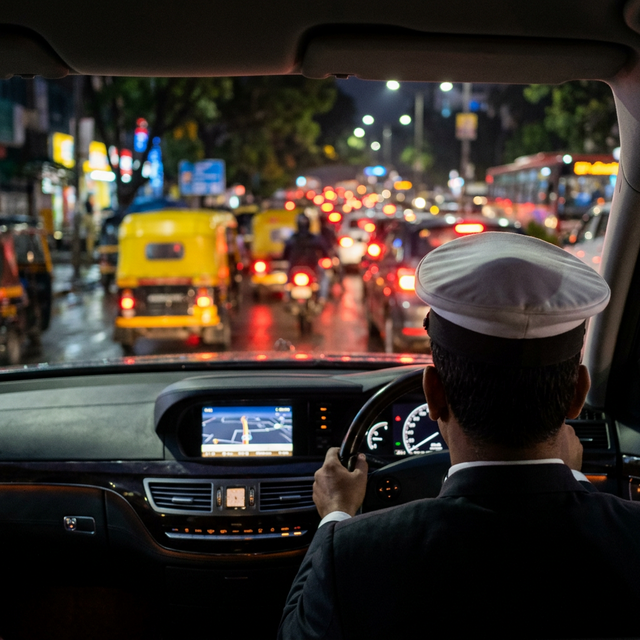
"In Bangalore, the fastest route isn't always a straight line. It's often a sequence of calculated pivots and hyperlocal intelligence."
If you've ever spent two hours traveling from Indiranagar to Whitefield, you know that Bangalore's traffic is less of an obstacle and more of an ecosystem. To thrive within it, you need more than just a car; you need a strategy. At OneD, our professional chauffeurs navigate these streets for 10+ hours daily. Here is their distilled wisdom on how to survive, and even beat, the Silicon Valley crawl.
1. The 'Invisible' Grid: Beyond Google Maps
While Google Maps provides a bird's-eye view, it often lacks the nuance of 'gridlock ripple effects'. Our drivers use 'Micro-Sequencing'—understanding that a jam at Silk Board will inevitably choke the inner lanes of Koramangala 15 minutes later. The pro tip? Don't just follow the blue line—monitor the *rate* of color change (red to dark red) on your route. If the red is darkening, pivot immediately to the nearest layout backroad before you enter the bottleneck.
2. Strategic Timing: The 'Golden Windows'
Bangalore traffic operates in highly predictable waves. The absolute worst windows are 8:45 AM – 10:15 AM and 6:00 PM – 8:30 PM. However, there is a 'Golden Window' between 3:00 PM and 4:30 PM where school buses have finished their runs and the IT shifts haven't yet released. If you can schedule your deep-city cross-travel during this window, you can reduce your travel time by up to 50%.
3. Lane Discipline: The 'Zen' Strategy
The instinctive reaction to traffic is to constantly switch lanes in search of a faster moving gap. This is a fallacy. In Bangalore's stop-and-go environment, lane-hopping actually increases your stress and risk of minor collisions without providing significant time gains. Our chauffeurs practice 'Zen Lane Discipline'—picking the middle-left lane (to avoid the erratic behavior of buses on the far-left and the fast-moving but often jammed far-right) and staying put. It saves your 'mental battery' for when you actually need it.
4. Reclaiming the Commute
The ultimate pro tip isn't about how to drive faster, but how to drive *less*. When you hire a OneD chauffeur, the traffic belongs to them, while the time belongs to you. Whether it's catching up on essential sleep, conducting research, or simply enjoying a podcast without one eye on a lane-splitting scooter, the backseat of your car becomes your most productive room in the house.
Typical Bangalore Commute Times (Average)
| Route | Peak Hour | Golden Window |
|---|---|---|
| Whitefield to Indiranagar | 75-90 mins | 35-40 mins |
| HSR Layout to Manyata | 110-130 mins | 50-60 mins |
| Electronic City to MG Road | 90-110 mins | 45-55 mins |
| International Airport to JP Nagar | 120-150 mins | 75-90 mins |
Conclusion
Traffic in Bangalore is inevitable, but misery is optional. By mastering route timing, practicing lane discipline, and occasionally handing over the wheel to a professional, you can transform your relationship with the city's roads. Don't let the commute define your day—define the commute yourself.